
Is It Okay to Applaud at Mass? Here’s What Four Popes Have Said About It...
  1. Share
26 10

Has this happened at your parish?

It is fairly common to experience or hear about people applauding during or at the end of Mass.

Whether it be for the priest after a homily, for a cantor, or even for the choir after the liturgy has concluded. Is this really okay?

Recently, YouTube personality Lizzie Reezay brought the point to light:
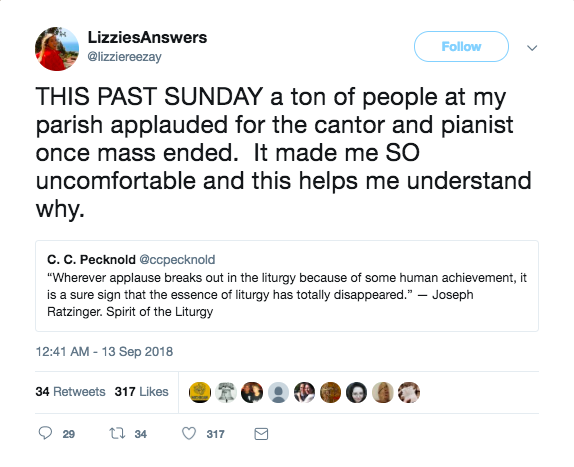
Her tweet reads, “THIS PAST SUNDAY a ton of people at my parish applauded for the cantor and pianist once mass ended. It made me SO uncomfortable and this helps me understand why.”

Below her tweet, she reposted a quote by Cardinal Joseph Ratzinger (before he was  Pope Benedict XVI).

Here’s what he said about applauding at Mass:

“Wherever applause breaks out in the liturgy because of some human achievement, it is a sure sign that the essence of liturgy has totally disappeared and been replaced by a kind of religious entertainment.Such attraction fades quickly – it cannot compete in the market of leisure pursuits, incorporating as it increasingly does various forms of religious titillation." (The Spirit of the Liturgy) 

Also, here is a video by Catholic Answers Live that gives us a little bit more perspective on the issue:

In the video, a caller, referring to the parish’s choir asks, “Is it appropriate to applaud for the choir after Mass? Is this an approved practice?”

Fr. Vincent Serpa said, “Absolutely not. It’s most inappropriate and it’s the responsibility of the pastor to make sure that the congregation understands this. The choir is not singing as a matter of entertaining anybody. They’re singing to worship God. We don’t clap for prayer. We pray.”

He continues, “Again, that is not an option. If we were someplace else it would be a different matte.r But Liturgy is liturgy. It’s the worship of God, and it need to be done in an appropriate way as the Church sees fit. It’s good that they appreciate the choir, but they can thank them outside. Applause is not appropriate at that time.”

Fr. Vincent adds, “There are times when that’s called for, as in the ordination ceremony when you are asked to give the response to the worthiness of the candidate for ordination. But this isn’t that. This is something else. You don’t clap at the end of Mass because you had a good time. That’s not what it’s about.”

Pope Saint John XXIII also said as people waited for him to arrive to a church outside of Rome, “I am very glad to have come here. But if I must express a wish, it is that in church you not shout out, that you not clap your hands, and that you not greet even the Pope, because ‘templum Dei, templum Dei.’" (‘The temple of God is the temple of God.’)

In a very powerful quote, Pope Saint Pius X said, “It is not fitting that the servant should be applauded in his Master’s house.”
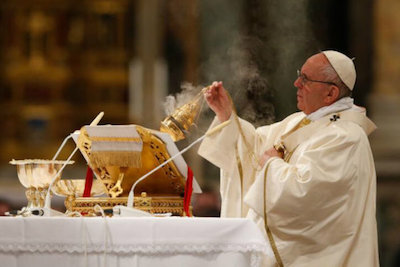
Finally, Pope Francis, not known for his interest in a more traditional perspective on liturgy also called the faithful to silence both before and after Mass, when he said,

“When we go to Mass, maybe we arrive five minutes before, and we start to chitchat with those in front of us,” the Pope said. However, “it is not a moment for chitchat.”

“It is a moment of silence for preparing ourselves for dialogue, a time for the heart to collect itself in order to prepare for the encounter with Jesus,” he said, adding that “silence is so important.”

The bottom line, there is no good reason for applause and chitchat. We spend very little time in the Holy Sacrifice of the Mass and we should use that time to turn our hearts and minds completely to God. We have plenty of time outside of Mass for fellowship and community engagement and applause has its place but it is not within the Mass.


This article has been edited but appeared in its original form in ChurchPop and is used with permission.

Image: Three Popes - Public domain Wikimedia Commons

Community tags

This content has 0 tags that match your profile.

The Church

Comments

To view comments or leave a comment, login or sign up.

Related Content

45
Reparation for Liturgical Abuse
Dear Apostoli Viae and other Catholic Family, As we head into Lent, my heart is drawn to deep gratitude for the glory of our tradition, our liturgy, and our faithful priests and bishops. I am grateful that Lent is beginning this week, and I am looking forward to the splendor of the Easter season that follows. I am especially grateful for courageous priests and bishops who offer faithful liturgical leadership that can and will draw our hearts more deeply into the heart of God. Stephanie and I were both blessed by this kind of faithful liturgy during our recent event in Virginia. It was moving to see reverence beautifully expressed by both clergy and laity in two parishes, both of which were Novus Ordo parishes that had and used their altar rails. At the same time, I am deeply grieved by the constant liturgical abuses that Our Lord and His bride suffer every day around the world which comes both through the clergy and the laity throughout the offering of the Holy Sacrifice of the Mass. The worst of this abuse occurs when the laity receive Communion in a state of mortal sin. With respect to God, this is a sacrilege similar to dumping the Body or Blood on the floor and trampling Him underfoot. Scripture reveals that approaching the sacrament in a state of mortal sin results in the horror of “eating and drinking damnation.” (I Corinthians 11:27) Reflecting on this vital issue of our faith leads me to propose to you something that we can all do together, either in part or whole, that militates against these grave sins against our Lord. For a number of years I have daily undertaken two penitential practices in the context of the Holy Sacrifice of the Mass that I would ask you to prayerfully consider adopting during Lent this year (and maybe even beyond Lent as a permanent offering). One practice offers reparation for abuses by the laity and the other for abuses perpetrated by clergy, along with intentions for the protection of faithful clergy. Here are a few proposals that you can undertake in whole or in part: For Abuses by the Laity: As an act of reparation and petition, inconspicuously kneel on the floor, rather than a kneeler, during all appropriate times in the Mass and before and after during preparation and thanksgiving. This quiet and humble kneeling draws us to a deeper expression of humility, and the pain or discomfort is then offered for reparation of the sins of irreverence or sacrilege. Here are a few examples of common abuses that require reparation: Receiving the Eucharist in a state of mortal sin. Irreverence in reception of the Eucharist. Disrespect or usurpation of the place of the priest through liturgical posture, prayers, or roles. Talking before, during, or after Mass about things unrelated to the Mass and disturbing those who desire to prepare, pray, worship, and offer thanksgiving. Clapping during the Mass.   For Abuses by the Clergy: Pray the Litany of the Most Blessed Sacrament (composed by St. Peter Julian Eymard) after the reception of Holy Communion. I have found that this beautiful litany is easily prayed after the reception of Communion even in small parishes if one is seated near the front. If it can’t be completed by the time of the dismissal, it can be finished after Mass during the traditional time of thanksgiving. Offered in thanksgiving for the gift of receiving the Lord in the Eucharist, for reparation for offenses against the Blessed Sacrament, restoration of reverence and faithful liturgy and teaching, deep faith in the Real Presence of our Lord in the Holy Sacrifice of the Mass, and for the protection and promotion of holy and faithful laity, priests, religious, and bishops. Lord, have mercy.                    R. Lord, have mercy. Christ, have mercy.                 R. Christ, have mercy. Lord, have mercy.                    R. Lord, have mercy. Christ, hear us.                         R. Christ, graciously hear us. God the Father of Heaven,      R. have mercy on us. God the Son, Redeemer of the world, R. God the Holy Spirit, R. Holy Trinity, one God, R. Jesus, Eternal High Priest of the Eucharistic Sacrifice, R. Jesus, Divine Victim on the Altar for our salvation, R. Jesus, hidden under the appearance of bread, R. Jesus, dwelling in all the tabernacles of the world, R. Jesus, really, truly and substantially present in the Blessed Sacrament, R. Jesus, abiding in Your fullness, Body, Blood, Soul and Divinity, R. Jesus, Bread of Life, R. Jesus, Bread of Angels, R. Jesus, with us always until the end of the world, R. Sacred Host, summit and source of all worship and Christian life, R. Sacred Host, sign and cause of the unity of the Church, R. Sacred Host, adored by countless angels, R. Sacred Host, spiritual food, R. Sacred Host, Sacrament of love, R.  Sacred Host, bond of charity, R. Sacred Host, greatest aid to holiness, R. Sacred Host, gift and glory of the priesthood, R. Sacred Host, in which we partake of Christ, R. Sacred Host, in which the soul is filled with grace, R. Sacred Host, in which we are given a pledge of future glory, R. Blessed be Jesus in the Most Holy Sacrament of the Altar. (3 Times) For those who do not believe in Your Eucharistic presence,   R. have mercy, O Lord. For those who are indifferent to the Sacrament of Your love,   R. have mercy on us.  For those who have offended You in the Holy Sacrament of the Altar,   R. have mercy on us. That we may show fitting reverence when entering Your holy temple, R. we beseech You, hear us. That we may make suitable preparation before approaching the Altar, R. That we may receive You frequently in Holy Communion with real devotion and true humility, R. That we may never neglect to thank You for so wonderful a blessing, R. That we may cherish time spent in silent prayer before You, R. That we may grow in knowledge of this Sacrament of sacraments, R. That all priests may have a profound love of the Holy Eucharist, R. That they may celebrate the Holy Sacrifice of the Mass in accordance with its sublime dignity, R. That we may be comforted and sanctified with Holy Viaticum at the hour of our death, R. That we may see You one day face to face in Heaven, R. Lamb of God, You take away the sins of the world,   R. spare us, O Lord. Lamb of God, You take away the sins of the world,   R. graciously hear us, O Lord. Lamb of God, You take away the sins of the world,   R. have mercy on us, O Lord. V. O Sacrament Most Holy, O Sacrament Divine,    R. all praise and all thanksgiving be every moment Thine. Let us pray: Most merciful Father, You continue to draw us to Yourself through the Eucharistic Mystery. Grant us fervent faith in this Sacrament of love, in which Christ the Lord Himself is contained, offered and received. We make this prayer through the same Christ our Lord. Amen. Many believe the sexual and power abuse crises we face today are rooted in the sexual drive and ambition of the perpetrators. These are only symptoms. The root issue is unbelief and the failure to orient our hearts and minds to the reality of the One who has given all for us and does so through the Holy Sacrifice of the Mass. If, by His grace, we can heal the liturgy, the healing of the Church will follow. If you decide to join me in these offerings of reparation, I have no doubt that God’s grace and forgiveness will pour out on His people and that we will contribute to a lessening of these abuses and the triumph of the glory and joy that is faithful Catholicism. Be holy. Be a light to the world. Yours in Christ, Dan Burke Unum est Necessarium
