Feast of St. Teresa of Avila - October 15th - Carmelite Saints

  1. Share
21 10

“Let nothing disturb you,

Let nothing frighten you,

All things are passing away:

God never changes.

Patience obtains all things

Whoever has God lacks nothing;

God alone suffices.

These are the words that can start a quest in your heart.  Simple to understand.  Difficult to live, even in a life where each day begins with mental prayer.  By asking her help and staying committed to mental prayer, we can humbly request a gift of deep connection with God as she encourages us to seek. Indeed, we may not experience the connection to Him to the depth she realized it, as we see by her pierced heart, but we can ask for the grace to know that alone is enough.  

On this, her Feast Day, as we recite the last of her Novena, let us consider soaking in her wisdom as our Novena prayer has recommended. Remembering Dan’s presentations about her Four Waters may help.  Here they are simplified for brevity’s sake and not connected to all their meanings with regard to prayer, but more to God’s actions.  In gratitude for her example, consider: 

First, drawing water from the well was not easy for St. Teresa.  She had to pull the rope, step on it to hold the heavy bucket as it was slowly brought back up full of water, and then pull again. When we start praying, this is the work we are doing.  We work hardest here against our distractions, and that work lets us see clearly it is His grace that allows detachment from the world so as to focus on Heaven.

Second, water coming in from a water wheel symbolizes less work on our part as the water flows in by its own weight, operating the wheel and pouring it into the garden of our soul.  Again, we see God doing the work, pulling out weeds (vices), and planting good plants (virtues).  We simply cooperate with His grace.

Third, a stream or gentle river that pours his grace into our soul with less noise and less effort than a water wheel is where our soul opens to receive the life-giving flow in silence and without many barriers.  The water simply soaks into the soil of our soul near the stream causing yet more growth that we cannot control.  Where the stream flows, it becomes His gentle incessant request for us to surrender to His soaking our soul with His grace and opening ourselves to His love.

Fourth, the rain, the gentle rain that falls from above, cleaning all, leaving all new, yet evenly watered.  A steady, soft rain where we do not control where it falls, nor how long it falls, nor how deeply it penetrates for all of that is up to God and we are overjoyed at however He causes it to happen in our souls.  Even when the resulting growth is not predictable, we rejoice, praising God for that growth  is deeper and less limited to being in the area near it like the growth that can only happen where the stream runs.

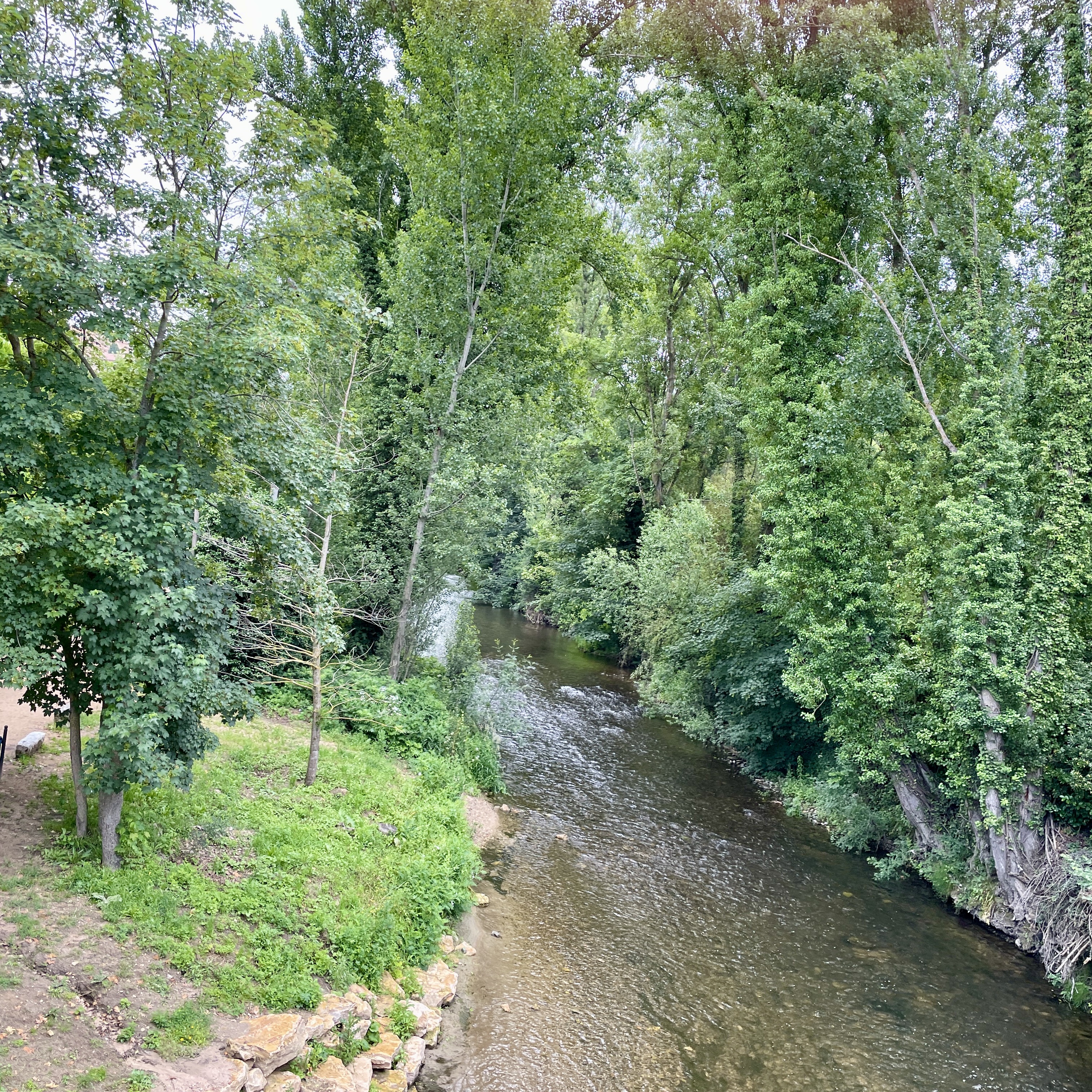
St. Teresa lived in a time where water was a precious commodity, and in a country where it can be scarce even in this time.  To appreciate this, consider the photo below that shows the Eresma river, which receives water from its tributary that supplies water for the city of Ávila.  This shows what those of us who might be used to the Amazon, the Mississippi, or the Ohio and many other smaller rivers in other parts of the world would designate as a stream.  It's dry banks show the characteristic dryness of Spain.
Because of it's precious status, the very practical St. Teresa used water in the very practical, real experiences we have with it in the various ways we receive it to teach us truths that can be grasped relatively easily with the mind, but take years of time to assimilate into our hearts.  So take heart, pilgrims on the face of the Earth, and yearn for the graces of Heaven that are limitless and not scarce.  Yet we should find ourselves yearning for them as a traveler in a dry area would yearn for water.   

St. Teresa of Avila, pray for us to remain in the springs of His salvation as He promised:

37 On the last day of the festival, the great day, while Jesus was standing there, he cried out, ‘Let anyone who is thirsty come to me, 38and let the one who believes in me drink. As the scripture has said, “Out of the believer’s heart shall flow rivers of living water.” ’ Jn. 7: 37-38.

Let us thirst for God in community, with clarity and accountability!

Image: St. Teresa, statue in Ávila, Spain (2023 pilgrimage)


Community tags

This content has 0 tags that match your profile.

Comments

To view comments or leave a comment, login or sign up.

Related Content

22
St. John of the Cross - Feast, December 14th - Carmelite Saints
St. John of the Cross - December 14th - Carmelite Saints Doctor of the Church.  Author of Spiritual Canticles. Living Flame of Love. Ascent of Mount Carmel and poetry so sublime it is studied by Spanish literature students still!  Our beloved saint was born in Fontiveros, Castile, Spain, most likely in 1540.  As Dr. Lilies has pointed out, his childhood was not easy.  His father, who had married a woman his family felt was beneath them died when John was about 3 years old. When she went to their uncle for help, she was refused.  Two years later, Juan’s older brother, Luis, passed away, possibly from malnutrition.  By 1551, his mother had moved to Medina del Campo, where she could find work.  This is the place where Juan eventually met St. Teresa of Ávila.  It is, even today, a small place, removed from main roads.  A place set apart where two great contemplative mystics and doctors of the Church were to meet. And there, in that quiet, humble place, a small statue above a locked door invites us into his teachings of letting go of all attachments.   For our dear St. John could have been attached to an anger against those who refused to help his mother after his father died.  Or he could have become attached to a desire never to be poor to avoid the suffering he endured as a child.  Instead, he walked straight into the storm, realizing that suffering purifies when endured with Christ for Christ and in Christ.   By 1567, he had joined the Carmelite order, and had sought and received permission from his superiors to live a more austere life than that commonly lived at the time.  At this important moment, he met and was encouraged by St. Teresa of Jesus (or of Ávila).  He formed the Discalced Carmellites Order with her and promoted it with great sufferings untl his death in 1591.   As he deepened his knowledge of what St. Teresa was doing in her reform, she invited him to be the confessor at the Monastery of "La Encarnación" (the Incarnation). The importance of his role as confessor at Encarnación cannot be ignored.  All the deep connections made between a holy confessor and his penitents surely helped that convent to progress in holiness!  As a testimony to his work there, he is remembered, as we see by the careful keeping of the chair he used for his work among their souls as their confessor.   The Spanish says “Chair used by St. John of the Cross when he was doing confessions in this Monastery.”  Certainly, it does not look comfortable, at least to our modern eyes! In that time of struggle for holiness, St. John was encouraged by a vision of Jesus on the Cross as seen from above.  The sketch he made has influenced artists across the centuries, and contemplating it certainly causes some small awareness of the Father’s love for us that allowed the Gift of His Very Son dying on the Cross to open the gates of Heaven for us who do not deserve to be there. Certainly this reminder of the Father’s love, the Son’s love and the Holy Spirit’s love must have strengthened St John through his imprisonment in Toledo.  Probably nutritional deficiencies there as well as from childhood led to constant sufferings originating from his digestive system, which eventually led to his death at Ubeda.  His remains were transferred from there to Segovia and then transferred back.  Graces flowed from those remains in such an abundance that by 1603, by order of the Order’s Superior General, his works were gathered to be sent to Rome to begin the canonization process.  By 1614, they were sent to Rome.  Some places say he was beatified by 1667, yet at Segovia, the place where his remains were housed in an incorrupt state until his beatification, a sign says he was beatified in 1675. His sainthood was declared in 1726, and two hundred years later, in 1926, he was named a Doctor of the Church.   His many writings attest to his interior life and love of God and call us to a silence and detachment from all things earthly, for even a string, however small, will keep us from our flight to heaven (see Ascent of Mount Carmel, specifically in Book One, Chapter 11, Section 4)  They show us a love that helps us to realize all that is given here calls us to that greater love that is unimaginable to us here, yet intimated by what we can perceive.  He served in Segovia where the route he walked each day is still marked by plaques such as the one below: The quote is from Spiritual Canticles Stanza 17 (p. 473 in the Complete Works of St. John of the Cross, 3d Ed. Kieran Kavanaugh, OCD) Be still, deadening north wind;  south wind, come, you that waken love, breathe through my garden, let its fragrance flow, and the Beloved will feed amid the flowers. In St. John's poem, the soul speaks here to her Beloved, Christ.  What might our soul resemble if we let go of what stills our love of God?  What if we were to allow the warm flow of Heaven’s air to awaken in us such a fragrant love of God that flowers should blossom in our souls? What if these flowers that feed the Lamb of God should begin to grow there?  May God grant that as we sit in silence before Him in Eucharistic Adoration, we may so desire to love Him that our hearts are inflamed and our souls should become living Gardens for Jesus! Photos courtesy of an AV Disciple from 2023 Spain Pilgrimage.   images from pilgrimage to Spain with Dan and Stephanie Burke.  Taken by a pilgrim used with permission.