
St. Teresa Margaret Redi - September 1 - Carmelite Saints
Also called St. Teresa Margaret of the Sacred Heart, she was a Saint who loved God so much that her defining contemplative moment was hearing the words “God is love” (1 Jn 4:8 and 1 Jn 4:16). She lived them out being the Infirmarian, in charge of caring for anyone in the Carmel who was sick. She was devoted, kind and caring even to those who were difficult. Certainly, Our Lord had prepared her for this as the oldest of 8, whose mother’s fragile health required that she care for younger siblings from an early age.
Her life spanned only a few short years: from 1747 to 1770. At age 9, Maria Christina Redi, also called Anna Maria, was sent to a Benedictine boarding school as her family was of lower nobility and moderately wealthy. She was a simple, unassuming child who could be mischievous at times, and who received her Sacraments at early ages, not in the order we are accustomed to receive them now: Confession at 7, Confirmation at 9, and Eucharist at 10. Her Father, Ignatius, had recognized her depth of piety and, as a pious person himself, began to provide her with spiritual direction as she began to ask about God and engage in conversations reflecting on the meaning of the Gospel they had heard at Mass. He served as her first spiritual director from 1757 to 1761. Since she left their home to attend school in 1756, this direction took place by letter. She said of him later as a Sister: "So great was the good my father has done to my soul that I can truly claim that he has been my father twice over.” What a beautiful way for a child to see her parent! Interestingly, all but one of her siblings became either a religious or a priest. Her father even gave up the status of having a coach to afford to send them all to school, and this sacrifice certainly showed young Anna Maria what it meant to love God more than worldly things.
Her father was of great assistance to her, as she desired not to stand out at the school, and taking extra time in Confession for direction would have made her be noticed. Yet, her piety was observed and the Sisters moved her First Communion up to a year sooner than usual. When she went on a retreat, the priest there Dom Pelligrini, realized her piety and became her spiritual director. He instructed her in mental prayer and in growing virtues. She constantly strove to grow in holiness while remaining unnoticed as different from anyone else. Apparently, she succeeded, for other students said she was good but ordinary.
The call to Carmel came in an unusual way. Anna Maria felt called to the religious life and loved the Benedictine Sisters who had educated her. A casual friend returned to the school to say goodbye before entering Carmel and asked Anna Maria to speak with her. Yet the two girls had no chance to talk. So they said a silent goodbye with a hand clasp as the friend was leaving. When Anna Maria returned to her room, she heard a voice say: “I am Teresa of Jesus and I want you among my daughters.” When 17-year-old Anna reacted by going into the Church and kneeling before the Tabernacle, she heard the same words again. She returned home from boarding school that year, 1763, and by September of 1764, at age 18, she was accepted into the Carmel of Florence. Her progress as a postulant was rapid, for God was preparing her for contemplative graces and service beyond self before her death only 6 years later in 1770. Her writings reveal a deep interior life, where she suffered from a longing to love God more deeply, and yet in her eyes saw only her failing to love Him even as she was growing in love for Him.
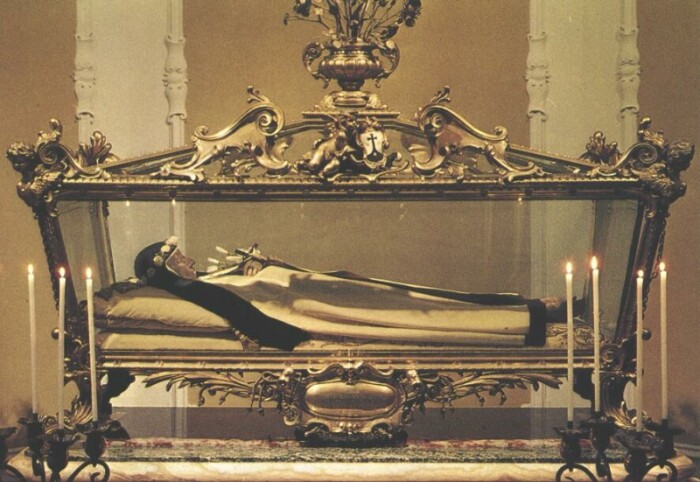
As Infirmarian, she was able to give herself in loving service to others. And it is in that giving, as she was lifting the body of a nun who had passed away, a hernia happened. She asked her then spiritual director, Fr. Ildefonso, for a general confession and to make Communion. This was her Last Viaticum as her death process was so quick that when a priest was called, all he got to do was anoint her. Although she died bloated with grayed extremities, after death, her stiffened body became supple and her skin returned to normal tones, becoming so lovely that a painter was called to paint her in the 18 days between her death and her burial. The Archbishop of Florence, who was called to examine her, declared that the smell there was “the odor of sanctity.” He referred to the beautiful scent that had become noticeable in the room where she was in the coffin. Her mother also noticed and reported it in parts of the villa where she spent her childhood. To this day, she remains incorrupt. Her body was placed in the nuns choir in the Florence, Italy Carmel in 1805 and can be venerated there. Miracles occurred and a cultus to her took place soon after her death. The decree of heroic virtue took place in 1839, her beatification in 1929, and her canonization on the Feast of St. Joseph, March 19, 1934.
A quote to take to heart:
"Always receive with equal contentment from God's hand either consolations or sufferings, peace or distress, health or illness. Ask nothing, refuse nothing, but always be ready to do and to suffer anything that comes from His Providence."
Her feast day is September 01. St. Teresa Margaret of the Sacred Heart, pray for us, that we may progress in mental prayer, the virtues and longing to love God as you did!
Related Content


Comments