St. Thérèse of Lisieux - October 1st - Carmelite Saints

  1. Share
8 10

Doctor of the Church, and inspirer of so many through her autobiographical work, Story of a Soul, written in obedience to her Mother Superior (who happened to be her sister!), St. Therese of Lisieux is a go-to Saint for those who are young, or young in their spiritual life and those who are further along in their spiritual life.  She reveals deep treasures of love for even those most advanced souls.  When anyone spends time with her in prayer by meditating on her writings; she brings them to a simple knowledge of the love Jesus has for us.  For both points on the spiritual path, those beginning and those well-experienced with the climb, we offer the following little thoughts about her on her Feast.  May you give her a white rose in prayer, and may she shower you with her heavenly blessings in return, taking you in the elevator to Jesus!

James 4:7 Draw near to the Lord, for He will draw near to you.  
St. Thérèse understood this to mean that God gives us a desire for Him, and He will respond when we respond to that desire.  
2 Corinthians 12:9-10 "My grace is sufficient for you, for my power is made perfect in weakness. Most gladly therefore will I rather glory in my weaknesses, that the power of Christ may rest on me"  
In her examination of conscience and refusal to close in upon herself in false humility, she exemplified this saying of St. Paul’s.  In her Little Way, she did not try to escape the faults and flaws that she could see; rather, she accepted this reality and trusted God to come to her where she was and bring her to where He wanted her to arrive.  It is in this confidence that she teaches us to see desolation, realize that it is heavy, and it is a normal occurrence, and not one of which we should be ashamed.  Most importantly, she teaches that we must ask the Lord’s help to fight against the heaviness that surrounds us.  
 
St. Teresa of Calcutta said that the reason St. Thérèse was canonized derived from her ability to do small things in great love.  And so Mother Teresa advocated for all her Missionaries of Charity to emulate St. Thérèse.  Doing these small things with great love is not simple, nor is it just a light-hearted lark.  For St. Thérèse, it sometimes entailed praying for those who belittled her and who did not see her as a valuable member of the community.  As she carried out the assigned the task of laundry, enduring being splashed; she prayed for those who splashed her and refused to think about whether it was purposeful or not.  As she helped the novices, as she carried out the tasks designated for her in that environment lacking many conveniences many of us consider indispensable, she realized the huge value all our acts on earth.  Yet, she did all of those acts so simply and so lovingly that when she was in the infirmary, she came to overhear a conversation where two of her fellow sisters commented that they did not know what would be written about Sister Thérèse because she was so unremarkable.

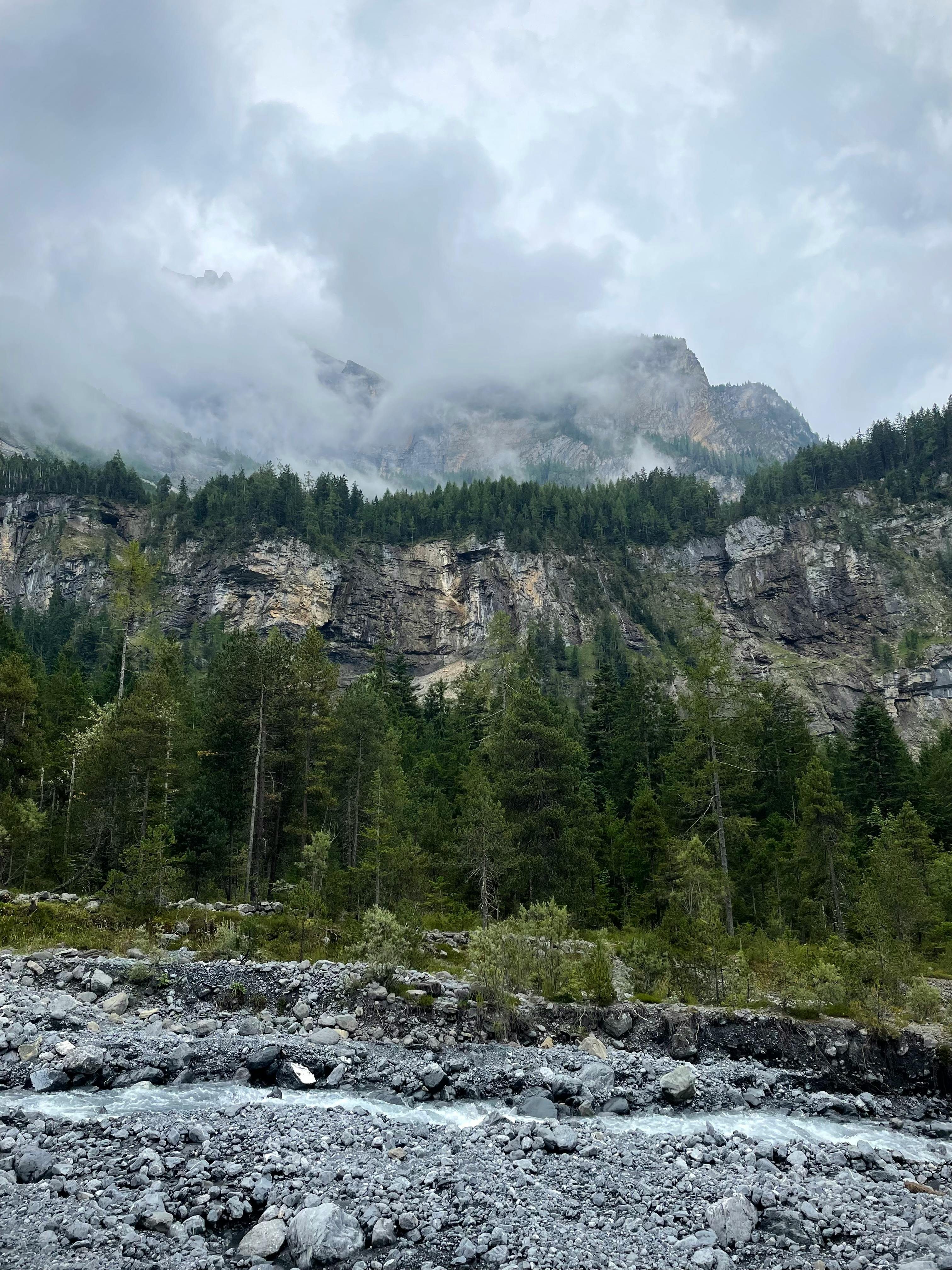
St. Thérèse made a pilgrimage to Rome when she was 15, during which she could gaze upon the amazing Alps of Switzerland.  And later, this memory served her to explain that God was lost in the summit shrouded by clouds and she was like a little grain of sand trampled underfoot at the bottom.  When she uses the beauty of nature to explain her relationship to God, she teaches us that He is constantly seeking to deepen the relationship He wishes to share with us.  In the enclosed atmosphere of the Carmel at Lisieux, she allowed Him to fill her with love and use her memories in a way to express just how far a journey it is to Him.  Had she done what many do, she would have sought Him in more and more experiences pursued without reflection or the purpose of deepening our relationship with the Lord.  And the heights of love she experienced within the Carmel, in a life of reflection, where seeking His love and to love Him in all those around her would have been lost to all of us. 
In her short life, she left us with so many lessons, and to not beleaguer you, here this reflection ends.  May you seek her wisdom in loving all around you in simplicity and trust, asking the Lord for help at every turn, never relying upon yourself, but upon Him and all those around you.  May you seek to love Him and want to go to Him as she did, and in that seeking climb up the mountain with great joy, even though you may feel like a grain of sand.  Most certainly, our Good Lord will provide that you become stuck in the sandal of a climber who is going up to Heaven, where He desires you to be with Him for all eternity.


Alps picture from Igor Melaschenko via Pexels
St. Thérèse and her sister Celine in 1881 from records of the Carmel of Lisieux

Community tags

This content has 0 tags that match your profile.

Comments

To view comments or leave a comment, login or sign up.

Related Content

136
Feast Day of St. Thérèse of Lisieux - October 1st
St. Thérèse's of Lisieux was a discalced Carmelite nun, known as "The Little Flower of Jesus" or simply, "The Little Flower."  She was one of nine children. Her parents were Saints Louis and Zelie Martin.  Born January 2, 1873, Thérèse felt an early call to religious life, and a the age of 15, joined her two older sisters in the cloistered Carmelite community of Lisieux.  St. Thérèse's approach to the spiritual life was practical and simple. While others declared that sanctity was difficult to attain, "The Little Flower of Jesus" said it was easy. According to Thérèse, we do not need extraordinary graces, rigorous penances, or an abundance of practices. We need only to acknowledge our "nothingness" and approach God with love and confidence. She said, “Sanctity is an interior disposition which make us humble and little in God's arms, conscious of our weakness and trusting even to audacity in the goodness of our Father."  In other words, we are like little children who can do absolutely nothing on our own and must rely completely on our loving father.  Such simplicity.  During her nine years as a Carmelite religious, Thérèse served as sacristan and assistant to the novice mistress. She died from tuberculosis at the age of 24. Pope St. Pius X called her "the greatest Saint of modern times." St. Thérèse is one of the four female Doctors of the Church. The others are St. Teresa of Avila, St. Catherine of Sienna, and St. Hildegard of Bingen. St. Thérèse's Feast Day is October 1st. May she inspire us to always remain little.  And may this quote of hers inspire us to love our neighbor, fully recognizing our littleness.  For when we love our neighbor who we can see we most certainly love the Lord Who we cannot see, but Who made our neighbor.  "True charity consists in bearing all our neighbor's defects – not being surprised at their weakness, but edified at their smallest virtues".   Let us look, then for every virtue around us and give due praise to the Lord for helping us to see it. St. Thérèse of Lisieux, pray for us!   
114
Feast of St. Teresa of Avila - October 15th - Carmelite Saints
“Let nothing disturb you, Let nothing frighten you, All things are passing away: God never changes. Patience obtains all things Whoever has God lacks nothing; God alone suffices. These are the words that can start a quest in your heart.  Simple to understand.  Difficult to live, even in a life where each day begins with mental prayer.  By asking her help and staying committed to mental prayer, we can humbly request a gift of deep connection with God as she encourages us to seek. Indeed, we may not experience the connection to Him to the depth she realized it, as we see by her pierced heart, but we can ask for the grace to know that alone is enough.   On this, her Feast Day, as we recite the last of her Novena, let us consider soaking in her wisdom as our Novena prayer has recommended. Remembering Dan’s presentations about her Four Waters may help.  Here they are simplified for brevity’s sake and not connected to all their meanings with regard to prayer, but more to God’s actions.  In gratitude for her example, consider:  First, drawing water from the well was not easy for St. Teresa.  She had to pull the rope, step on it to hold the heavy bucket as it was slowly brought back up full of water, and then pull again. When we start praying, this is the work we are doing.  We work hardest here against our distractions, and that work lets us see clearly it is His grace that allows detachment from the world so as to focus on Heaven. Second, water coming in from a water wheel symbolizes less work on our part as the water flows in by its own weight, operating the wheel and pouring it into the garden of our soul.  Again, we see God doing the work, pulling out weeds (vices), and planting good plants (virtues).  We simply cooperate with His grace. Third, a stream or gentle river that pours his grace into our soul with less noise and less effort than a water wheel is where our soul opens to receive the life-giving flow in silence and without many barriers.  The water simply soaks into the soil of our soul near the stream causing yet more growth that we cannot control.  Where the stream flows, it becomes His gentle incessant request for us to surrender to His soaking our soul with His grace and opening ourselves to His love. Fourth, the rain, the gentle rain that falls from above, cleaning all, leaving all new, yet evenly watered.  A steady, soft rain where we do not control where it falls, nor how long it falls, nor how deeply it penetrates for all of that is up to God and we are overjoyed at however He causes it to happen in our souls.  Even when the resulting growth is not predictable, we rejoice, praising God for that growth  is deeper and less limited to being in the area near it like the growth that can only happen where the stream runs. St. Teresa lived in a time where water was a precious commodity, and in a country where it can be scarce even in this time.  To appreciate this, consider the photo below that shows the Eresma river, which receives water from its tributary that supplies water for the city of Ávila.  This shows what those of us who might be used to the Amazon, the Mississippi, or the Ohio and many other smaller rivers in other parts of the world would designate as a stream.  It's dry banks show the characteristic dryness of Spain. Because of it's precious status, the very practical St. Teresa used water in the very practical, real experiences we have with it in the various ways we receive it to teach us truths that can be grasped relatively easily with the mind, but take years of time to assimilate into our hearts.  So take heart, pilgrims on the face of the Earth, and yearn for the graces of Heaven that are limitless and not scarce.  Yet we should find ourselves yearning for them as a traveler in a dry area would yearn for water.    St. Teresa of Avila, pray for us to remain in the springs of His salvation as He promised: 37 On the last day of the festival, the great day, while Jesus was standing there, he cried out, ‘Let anyone who is thirsty come to me, 38and let the one who believes in me drink. As the scripture has said, “Out of the believer’s heart shall flow rivers of living water.” ’ Jn. 7: 37-38. Let us thirst for God in community, with clarity and accountability! Image: St. Teresa, statue in Ávila, Spain (2023 pilgrimage)